Georgia Renters: Your Landlord's Insurance Doesn't Cover You

There is a misunderstanding that costs Georgia renters every single year, and it usually surfaces at the worst possible moment.
A fire starts in the unit above yours. A break-in happens while you are at work. A pipe bursts and ruins everything in your bedroom. The building gets damaged, the maintenance team gets involved, the landlord contacts their insurance company — and that is when many renters learn the truth.
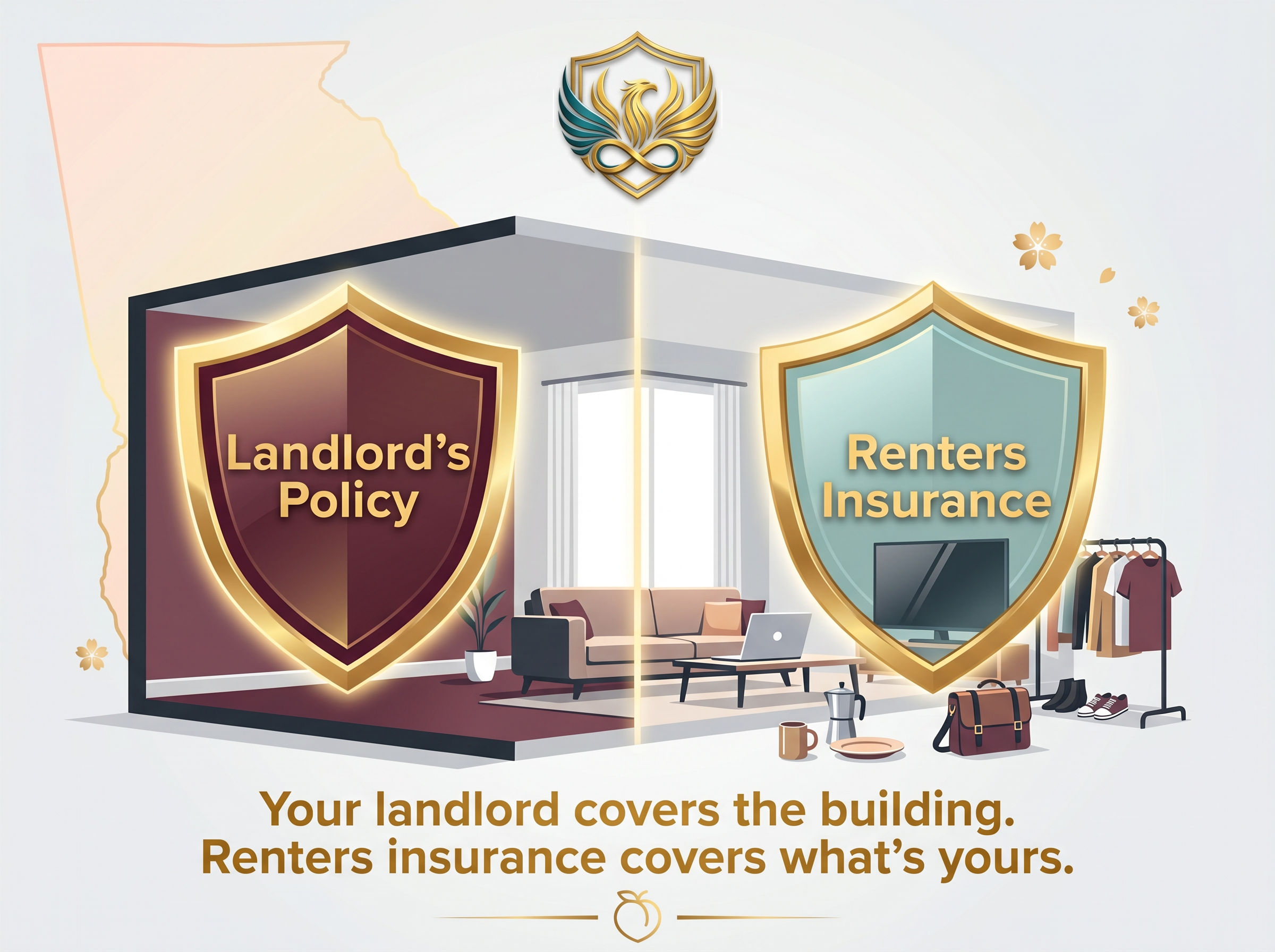
Your landlord’s insurance covers the building.
Not your belongings.
Not your personal liability.
Not the hotel room you may need while your apartment is being repaired.
That gap is exactly why renters insurance exists. And in Georgia, it remains one of the most overlooked protections available, even though it is usually one of the most affordable policies a renter can buy.
The Big Misunderstanding: “My Landlord Has Insurance”
Yes, your landlord has insurance. But their policy is designed to protect what they own.
That usually means the building, the roof, the walls, the plumbing, the electrical systems, and the landlord’s financial interest in the rental property.
It does not mean your personal property inside the unit is automatically protected.
Your sofa, laptop, television, clothes, shoes, kitchen equipment, children’s belongings, furniture, tools, gaming system, work gear, and personal items are your responsibility. If those items are stolen, burned, smoke-damaged, or ruined by a covered water loss, the landlord’s policy usually does not step in to replace them.
That is the line too many renters never see until they are already standing on the wrong side of the loss.
What Your Landlord’s Policy Actually Covers
A landlord’s property policy generally protects the physical structure they own. If a covered fire damages the apartment building, the landlord’s insurance may help repair the building. If a covered storm damages the roof, the landlord’s policy may help address the structural repairs.
But your personal property is separate.
That distinction matters because the landlord can have a valid insurance policy and you can still be uninsured for your own loss.
If your furniture is ruined by smoke, that is your property.
If your laptop is stolen during a break-in, that is your property.
If your clothing is damaged by water from a burst pipe, that is your property.
If your apartment becomes temporarily unlivable, your temporary living costs may become your problem unless you have the right coverage.
The landlord’s insurance is not designed to rebuild your life inside the apartment. It is designed to repair the landlord’s building.
What Renters Insurance Covers
A standard renters insurance policy typically focuses on three major areas: personal property, personal liability, and additional living expenses.
1. Personal Property Coverage
This is the part most people think about first.
Personal property coverage helps protect your belongings from covered losses such as fire, theft, smoke damage, vandalism, and certain types of internal water damage, depending on the policy.
That may include:
Furniture
Electronics
Clothing
Shoes
Appliances you own
Kitchen items
Tools
Books
Children’s items
Home office equipment
Music equipment
Sports gear
A good question to ask yourself is simple:
If everything in my apartment had to be replaced tomorrow, how much would it cost?
Most renters underestimate that number. A bedroom alone can easily hold thousands of dollars in clothes, shoes, electronics, furniture, and personal items. Add the living room, kitchen, bathroom, children’s rooms, and work equipment, and a small apartment can carry a much larger replacement cost than expected.
One important detail: confirm whether the policy pays replacement cost value or actual cash value.
Replacement cost value is based on what it costs to buy a comparable item new today.
Actual cash value factors in depreciation.
That difference matters. A three-year-old laptop, a two-year-old TV, and a worn sofa may not be worth much under actual cash value, even though replacing them may cost far more out of pocket.
2. Personal Liability Coverage
Renters insurance is not just about your belongings.
It can also help protect you if someone claims you are responsible for injury or property damage.
For example:
A guest slips inside your apartment and pursues a claim.
Your child accidentally damages a neighbor’s property.
A washing machine overflow causes damage to the unit below you.
A pet-related incident leads to a liability claim.
Without liability coverage, you may be left dealing with the financial impact alone.
Liability coverage does not mean every situation is automatically covered. Policy language, exclusions, limits, and facts matter. But this is one of the most important parts of renters insurance because liability claims can become expensive quickly.
3. Additional Living Expenses
This is the coverage renters often overlook.
Additional Living Expenses, sometimes called Loss of Use, can help pay extra costs if a covered loss makes your rental unit temporarily uninhabitable.
That may include:
Hotel stays
Temporary rental costs
Extra meal expenses
Additional transportation costs
Other necessary costs above your normal living expenses
Imagine a kitchen fire makes your apartment unsafe for three weeks. The landlord may be working on repairs. The building may be insured. But where are you sleeping tonight?
That is the real-world purpose of Additional Living Expenses coverage.
It does not pay for everything without limits. It is subject to the policy terms. But when a covered loss forces you out of your home, this coverage can turn a financial emergency into a manageable claims process.
What Renters Insurance Usually Does Not Cover
Renters insurance is valuable, but it is not unlimited.
Most standard renters policies do not cover every possible loss. That is why renters should review the policy instead of assuming.
Common limitations may include:
Flooding from outside the building
Earthquake damage
Certain sewer or drain backup losses unless endorsed
High-value jewelry above policy sub-limits
Collectibles, art, or specialty equipment above policy sub-limits
Business property beyond limited coverage
Roommate property unless properly listed or separately insured
Damage caused intentionally
Wear and tear
The flood issue is especially important.
Water damage from a burst pipe inside the building may be treated differently from floodwater rising from outside. Those are not the same insurance conversation. If your apartment is in a flood-prone area, ask specifically about flood coverage.
Do not assume “water damage” means every kind of water damage.
Georgia Renters Should Also Read the Lease
Some Georgia leases require renters insurance.
That means a tenant may need to provide proof of coverage before or shortly after move-in. If your lease requires it, do not treat it as a small administrative issue. Read the requirement carefully.
Confirm:
Minimum liability limit required
Whether the landlord must be listed as an interested party
Whether pet liability is excluded or included
Whether proof must be renewed every year
Whether failure to carry coverage creates a lease issue
An “interested party” is different from adding someone as an insured. A landlord may want notice if your policy cancels, but that does not mean they should be covered as if they own your belongings. Have the agent explain the wording before you agree to it.
How Much Does Renters Insurance Cost in Georgia?
Renters insurance in Georgia is usually affordable compared to the size of the risk.
Many policies fall somewhere around the cost of a streaming subscription or a few fast-food meals per month, depending on the carrier, location, coverage limits, deductible, claims history, credit-based insurance factors where allowed, and selected endorsements.
The exact price depends on the person and the property, but the bigger point is this:
The cost of not having renters insurance can be much higher than the monthly premium.
Replacing a laptop, bed, sofa, clothes, shoes, and basic household items after a fire or theft can run thousands of dollars. Paying for a hotel during repairs can create pressure fast. Defending yourself from a liability claim can be even more serious.
Renters insurance is not expensive because the coverage is small. It is affordable because the policy is focused. It protects the renter’s side of the risk, not the entire building.
Four Things to Confirm Before You Buy
1. Confirm Your Personal Property Limit
Do not guess too low.
A $10,000 personal property limit may sound like enough until you start adding everything you own. Walk room by room and estimate what it would cost to replace your belongings.
Include:
Bedroom furniture
Mattress
Clothes
Shoes
Electronics
Kitchen items
Bathroom items
Children’s items
Work equipment
Tools
Decor
Small appliances
A simple home inventory can make this easier. Take photos or videos of each room and save receipts for larger purchases. If you ever have a claim, documentation matters.
2. Ask About Replacement Cost
Replacement cost coverage is usually stronger than actual cash value because it focuses on replacing the item instead of paying its depreciated value.
That does not mean every claim is paid the same way. Some policies may pay actual cash value first and then reimburse the difference after you replace the item. Ask how the policy handles the claim before you need to use it.
3. Review Sub-Limits on Valuables
Some items have special lower limits inside the policy.
Ask about:
Jewelry
Watches
Musical instruments
Cameras
Firearms
Collectibles
Art
High-end electronics
Business equipment
If you own valuable items, you may need scheduled personal property coverage or a separate endorsement.
This is where a five-minute question can prevent a major claim disappointment later.
4. Know Your Deductible
Your deductible is the amount you pay out of pocket before the policy responds.
A higher deductible may reduce your premium, but it should still be an amount you can realistically handle during an emergency.
If your deductible is $1,000 and your stolen property claim is $1,400, the policy may not help as much as you expected. The deductible should match your real financial situation, not just the cheapest monthly price.
The Roommate Problem
Roommates create another common misunderstanding.
Do not assume your roommate’s renters insurance covers you.
In many cases, each renter should have their own policy unless the policy is specifically written to include both people properly. If you share an apartment and your roommate has coverage, that does not automatically mean your belongings are protected.
This matters after a theft, fire, or water loss. The insurance company will look at who is insured under the policy.
If your name is not listed correctly, you may not have coverage.
Renters Insurance and Auto Insurance
Many renters can bundle renters insurance with auto insurance.
The discount will vary by carrier, but in some cases, adding renters insurance can reduce the auto premium enough that the net cost of the renters policy becomes even smaller.
This does not mean the policy is free. It means the bundle may make the overall insurance plan more efficient.
If you already have auto insurance, ask what happens when renters coverage is added. Review both policies together. The goal is not just to buy another policy. The goal is to close the gap correctly.
When Renters Insurance Matters Most
Renters insurance matters most when life is already disrupted.
After a fire, you do not want to find out your belongings are your problem.
After a break-in, you do not want to replace everything from savings.
After a burst pipe, you do not want to argue over who pays for damaged furniture.
After your unit becomes unlivable, you do not want to search for hotel money under pressure.
After a liability claim, you do not want to face it alone.
Insurance cannot prevent the loss. But it can give you a process, a financial backstop, and a way to recover without starting from zero.
The Bottom Line
Renters insurance is one of the simplest protections available to Georgia tenants.
Most renters who go without it are not making a calculated financial decision. They either assume the landlord’s policy protects them, or they have not stopped long enough to measure what they actually own.
That is the risk.
A rental unit may not belong to you, but everything inside that makes it feel like home probably does.
If you rent in Georgia and do not have renters insurance, this is a conversation worth having this week. Not next month. Not after the lease renewal. Not after the neighbor’s pipe bursts or the apartment next door catches fire.
Before the loss happens, you still have options.
After the loss happens, you only have the coverage you already put in place.
Curtis is a licensed Georgia P&C insurance agent and the founder of CurtisNsurance. He writes for Georgia renters, homeowners, and families who want clear answers about how their coverage actually works — without the jargon.
Clear Guidance. Stronger Futures.
.png?width=940&height=788&name=CurtisNsurance_LOGO_01042026%20(1).png)